
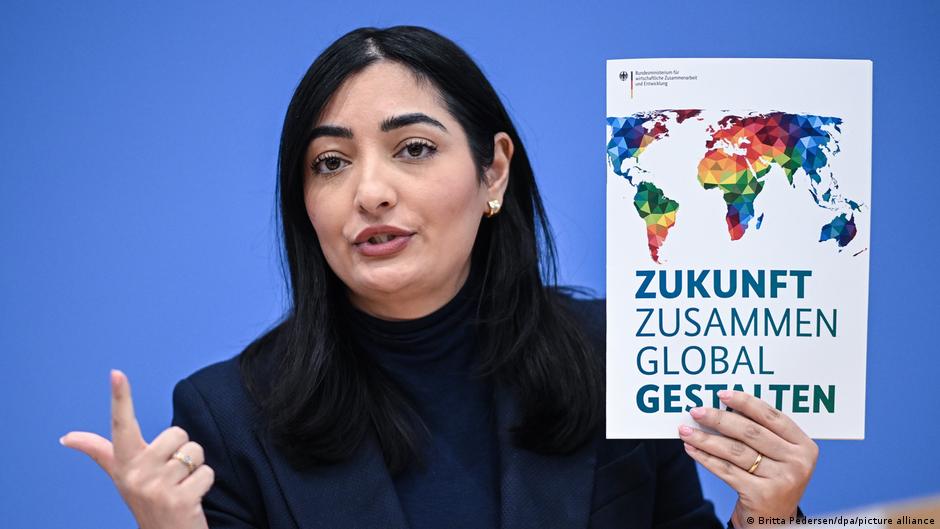
Germany’s Ministry for Economic Cooperation and Development (BMZ) will have just over €10 billion ($11,6 billion) at its disposal in 2026, down from almost €14 billion four years ago.
“We can’t do everything everywhere, so we’re consolidating our resources,” said Development Minister Reem Alabali Radovan as she presented her reform plan entitled “Shaping the future together globally” in Berlin on Monday. The 26-page paper is also a response to the massive cuts, with more to follow by 2029.
This comes at a time when the US, previously the world’s largest donor, has almost completely pulled out of development aid. International solidarity is under massive pressure, Alabali Radovan lamented. In view of the increasing number of crises and wars, Germany must adapt to the new realities, the minister said. “Development policy will become an even stronger building block of German national security, alongside diplomacy and defense,” she added.
In addition, the increasingly scarce funds are to be used more intensively to combat hunger and poverty. “We are not withdrawing from any partner country,” emphasized the minister, who has been in office since May 2025. “At the same time, however, it is abundantly clear that we will not be able to close the gap left by the US on our own, nor will we compete with China,” she told DW.
Development policy, diplomacy and defense
China, the world’s second-largest economy after the US, has long been involved in development policy, particularly in Africa. European observers have argued, however, that Chinese aid comes at a cost: It focuses heavily on infrastructure projects and raw material extraction, and is often financed through loans that are secured with natural resources, which in turn leads to mounting debt for African countries. Also, China is said to lack consideration for human rights and sustainability issues.
Germany’s goal, on the other hand, is to create value in the target countries and regions, said the minister: “Good jobs, good conditions in compliance with human rights standards and climate standards. And preferably, of course, with German or European companies.”
German development aid will also include a new form of cooperation with emerging economies, where overall economic development is strong. In the future, these countries will only receive support in the form of loans from the state-owned Kreditanstalt für Wiederaufbau (KfW). According to Alabali Radovan, potential recipients of these funds would include countries such as India, South Africa and Mexico.
German development aid for the reconstruction of Ukraine
In crisis regions, Germany wants to focus more on countries “that are of central importance to Germany and Central Europe.” The strategy paper refers to Germany’s eastern neighbors in Europe as well as the Middle East, North Africa, the Sahel region, and the Horn of Africa.
With regard to Ukraine and reconstruction after the end of Russia’s unlawful war, the German Development Ministry wants to take a leading role. At the same time, this is intended to achieve a strategic goal throughout the region: “In Southeast and Eastern Europe and the Caucasus, it is also a matter of counterbalancing Russian influence.”
The new German development policy strategy has met with mixed reactions from aid organizations and politicians. , sees both pros and cons. “It is important that commitment to the least developed countries in the Global South is strengthened and that modern instruments such as the localization of development cooperation are promoted even more strongly,” Carsten Montag, CEO of VENRO, the umbrella organization for development policy and humanitarian non-governmental organizations, told DW.
VENRO, which comprises around 150 organizations, took a critical view of the geopolitical and economic orientation. They say the German plan appears to focus primarily on national economic interests. “Development cooperation must not become a tool for promoting national interests but must continue to focus primarily on reducing global injustices,” Montag said.
The German NGO Welthungerhilfe, however, was generally positive in its comments to DW, welcoming the fact that hunger, poverty and inequality are clearly identified as the top priorities of German development cooperation. “After all, 673 million people still suffer from hunger, which is one in every 12 people in the world,” said Secretary General Mathias Mogge, referring to the global scale of the food crisis. The stronger focus on the least developed countries is also an important step in the right direction, he said.
Melanie Hauenstein, Germany director of the United Nations Development Programme (UNDP), is very satisfied with the reform plans: “It is only right that the Federal Ministry for Economic Cooperation and Development is structurally realigning its policy in times of global uncertainty,” she told DW. “Resilient international cooperation is essential right now to create security and prospects, especially in crisis areas.”
Hauenstein emphasized that Germany remains committed to the United Nations and international law. “This will strengthen Germany’s role in the world.” She added that the proposal by Reem Alabali Radovan’s ministry must be adequately funded by the federal government and parliament.
‘Militarization of development cooperation’
This is precisely where the criticism from the Left Party, an opposition party in the German Bundestag begins. Its spokesperson for global justice, Charlotte Neuhäuser, referred to the massive cuts in the development ministry’s budget in an interview with DW: “Never before have funds for people in the countries of the Global South been cut as drastically as under the current federal government.” In addition, Development Minister Alabali Radovan has announced even more cuts.
According to Neuhäuser, plans for a new German developmental cooperation policy are nothing more than a way of glossing over record cuts affecting those most severely impacted by the consequences of global exploitation, wars, and the climate crisis.
From the perspective of the Left Party, the reform plan is part of a global shift in international relations. “More efficiency in development policy means nothing other than budget cuts and privatization. More geopolitics means nothing other than a militarization of development cooperation,” argues Neuhäuser, pointing to the simultaneous increase in military spending worldwide.
This article was originally written in German.
While you’re here: Every Tuesday, DW editors round up what is happening in German politics and society. You can sign up here for the weekly email newsletter, Berlin Briefing.
