
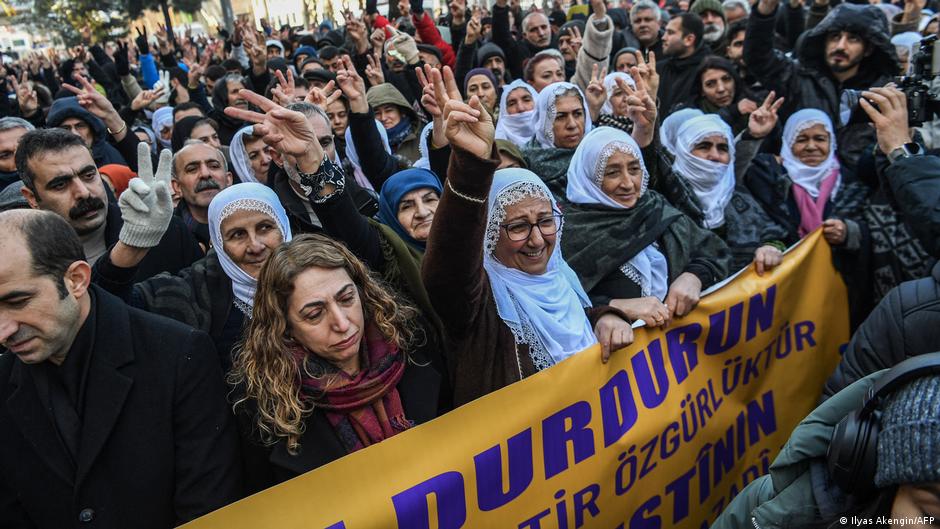
Syrian transitional government troops and Kurdish-led Syrian Democratic Forces (SDF) had been fighting for weeks in northern Syria. On Tuesday evening, the announcement of a four-day ceasefire restored a measure of calm.
SDF fighters were close allies of the international coalition battling the extremist “Islamic State,” or IS, group in Syria and managed to take control of strategically important areas in Syria during 14 years of civil war. Recent clashes with Syrian government troops has pushed them out of these areas.
The Syrian government accuses the SDF of disregarding a March 2025 agreement which required all Kurdish civilian and military institutions to be merged into the administration of the Syrian state and army by the end of 2025 — a plan that was never implemented. The Kurdish leadership, in turn, accuses the Syrian government of ignoring the rights of ethnic and religious minorities as it reorganizes the country after civil war.
These latest developments turn the global spotlight back onto a centuries-old issue: The fate of the Kurds, a community of over 30 million people without an independent state of their own, in one of the world‘s most volatile regions.
A people without a homeland
Some 30 to 35 million Kurds live around the world. But they are not a homogenous group. Different dialects are spoken in Kurdish regions. Religiously the Kurds also vary. While the majority belong to Sunni Islam, significant Alevi, Yazidi, Shiite and Christian communities also exist.
Historically, the Kurds lived in the area between Mesopotamia‘s Euphrates and Tigris rivers. Yet after the fall of the Ottoman Empire and the end the World War I, France and Britain split up what would have been a Kurdish homeland. The 1923 Treaty of Lausanne divided the area into four states: today’s Turkey, Iraq, Syria and Iran — thereby shattering the dream of an independent Kurdish state, as promised in the earlier Treaty of Sevres.
Today Europe is home to the largest Kurdish diaspora outside the Middle East, with Germany hosting the most Kurds.
Syria: Language bans, statelessness
After the partition of their homeland, many Kurdish tribes occupied areas in Syria along the Turkish border, until the Syrian government launched an Arabization campaign in the 1960s.
A 1962 census led to around 120,000 Kurds losing their Syrian citizenship. They were declared stateless and deprived of their right to property and ownership. Thousands were deported to the desert, with Arab tribes deliberately resettled in their ancestral homelands.
In the decades that followed, the Kurds experienced even further oppression, with bans on their languages, books and Kurdish names.
Today around 2.5 million Kurds live in Syria, making up around 10% of the total population.
During the Syrian civil war and the rise of the IS group in 2014 and 2015, a Kurdish paramilitary, the Syrian Democratic Forces, or SDF, became a US ally in the fight against the IS group. It was during this period that the SDF created a self-run region in northeast Syria. The SDF maintains close ties to the Kurdistan Workers’ Party, or PKK.
Turkey: Repression, armed struggle
Some 15 to 18 million Kurds live in Turkey. Yet for many decades, the country did not recognize them as a distinct ethnic group and minority. Until a few years ago the use of Kurdish language and Kurdish first names were banned.
In 1984, the PKK— designated a terrorist group by Turkey, the United States and the European Union — began an armed struggle against the Turkish state. Its initial aim was the creation of an independent Kurdish state although the PKK eventually pivoted to demanding Kurdish rights instead. In May 2025, the PKK announced its dissolution following a public appeal by its leader Abdullah Ocalan, who has been imprisoned in Turkey since 1999 after being convicted of treason.
Although a fresh attempt was made to start a peace process in Turkey, with the PKK signaling its willingness to disarm, talks have come to a standstill.
The Kurds want the release of imprisoned Kurdish politicians, an end to the Turkish administration of Kurdish cities, and a review of PKK founder Ocalan‘s prison conditions.
The Turkish government has been accused of supporting fighters in Syria who deliberately target Syria‘s Kurdish areas.
Iraq: Persecution and autonomy
The history of the 7 to 8 million Kurds in Iraq is one marked by suffering. But they are also the Kurds who have come closest to a homeland.
Under Saddam Hussein, the Kurds were subject to brutality. In March 1988 Hussein attacked the Kurdish city of Halabja with chemical weapons, killing at least 5,000 people, mostly civilians.
After the second Gulf War, the victorious US-led coalition enforced a no-fly zone over Iraq, allowing the Kurds to set up their own government in what would become a semi-autonomous region.
Since 2005, the Iraqi constitution has officially recognized this region. Politics in Iraqi Kurdistan are dominated by two families, the Barzanis and Talabanis and their respective political parties.
Iran: Assassination and protest
Approximately 8 to 10 million Kurds live in Iran.
The Iranian regime regards them as a threat to national unity, as they have taken a clear stand against the country’s religious leaders since the Islamic Revolution.
In 1989, the leader of Iran’s Kurdistan Democratic Party, Abdul Rahman Ghassemlou, was murdered in Vienna together with two Kurdish officials. Three years later, Kurdish politicians were murdered in Berlin and there were also other assassinations elsewhere in Europe. It is thought this was part of a campaign of transnational repression and assassination led by the Iranian regime.
Protests against the Iranian regime tend to flare up particularly fast in the Kurdish regions and are met by harsh government crackdowns.
The death of Jina Mahsa Amini, a young Kurdish woman, at the hands of the Iranian morality police in 2022, has etched itself in the collective memory.
All of this has led to the Kurds in Iran developing a new, powerful sense of self in recent years.
This article was originally published in German.
