
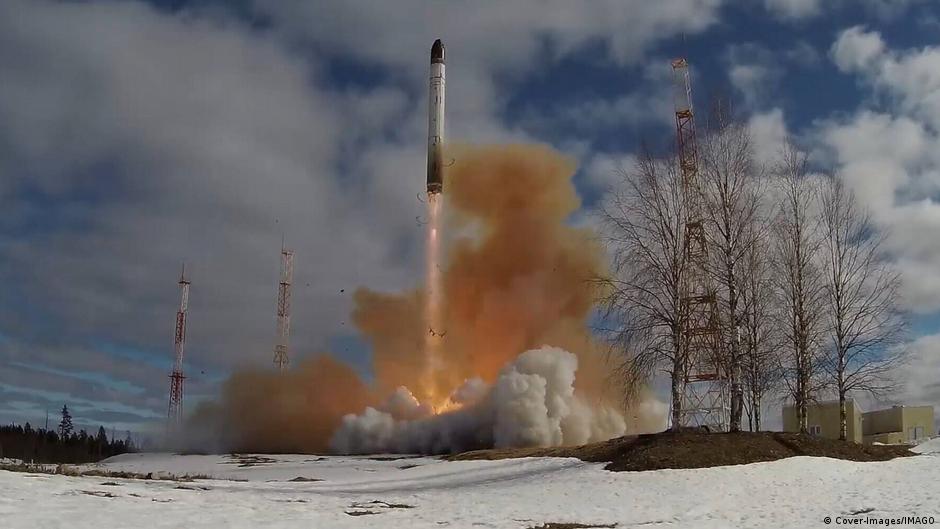
Time is running out: The nuclear arms reduction deal between the United States and Russia, known as New START, is set to expire by the end of Wednesday Eastern Standard Time (0500 Thursday UTC). Key world leaders, including Pope Leo XIV, have been publicly calling for the agreement’s extension or preservation.
START stands for Strategic Arms Reduction Treaty. The most recent bilateral deal between the US and Russia was signed by Barack Obama and Dmitry Medvedev as the respective presidents of the United States and Russia in 2010, and is the last remaining treaty on nuclear reduction between both nations. The first such arrangement can be found in the Strategic Arms Limitation Talks agreement (SALT-I), signed in 1972.
The New START agreement limits the number of deployed strategic nuclear warheads to 1,550 each, and the number of strategic delivery vehicles and systems — such as heavy bombers, intercontinental ballistic missiles (ICBMs) and submarine-launched ballistic missiles (SLBMs) — to 800 each. It also contains provisions for mutual inspections to verify the treaty is being upheld.
What about the ‘old’ START deals?
Previous START agreements include START I and START II. The former was initiated by then-US President Ronald Reagan during the Cold War, just months before the collapse of the Soviet Union. It was signed by Reagan‘s successor, President George H.W. Bush, as well as President of the Soviet Union, Mikhail Gorbachev. The agreement entered into force in 1994 and lasted until 2009.
START II, on the other hand, was agreed upon in 1993 but never entered into force due to rising tensions between Moscow and Washington at the time.
However, both powers remained committed to nuclear disarmament and returned to the table to hammer out a new deal. Signed and ratified in 2010, the new arrangement was quite literally hoped to be a new start.
The treaty was originally set to last ten years and expire in February 2021. At the time, US President Joe Biden, and Russian President Vladimir Putin agreed to adopt a five-year extension. Which brings us to the looming 2026 deadline.
What happens when the new deal expires?
Once the treaty expires, the world’s two largest nuclear powers will no longer be bound by upper limits for their strategic nuclear arsenals.
“This is very bad for global security,” Kremlin spokesperson Dmitry Peskov said at a press briefing on Tuesday.
Without intervention, the world could be facing another unchecked nuclear arms race.
An expiration of the deal would also usher in a new era of uncertainty, as the deal sought to foster predictability and transparency with provisions for on-site inspections and the exchange of data. The idea was to prevent one side from prematurely launching a nuclear attack based on bad information gathered from the other side.
What do Russia and the US hope to achieve?
In September 2025, Putin had offered that Russia would unilaterally adhere to the deal for a further year to allow for more time to renegotiate. At the time, US President Donald Trump said Putin’s proposal “sounds like a good idea,” but remained non-committal.
Both leaders were on good terms then — at the expense of Ukraine and the EU, as many European leaders feared.
But at some point, Trump appears to have changed his mind. Speaking about the New START accord with the New York Times in January 2026, he said, “if it expires, it expires,” and added he expected that “we’ll just do a better agreement.”
Apparently, Trump believes that China, the world’s fastest-growing nuclear power, should be integrated into the bilateral arrangement. He had already indicated as much during his first term in office, when he unilaterally canceled several nuclear or arms control agreements with Russia and — without success — suggested China should be involved in their continuation.
What does New START have to do with Russia’s war in Ukraine?
When Russia launched a full-scale invasion of Ukraine in 2022, relations between Moscow and Washington became frostier, but they did not initially affect the New START arrangement.
Half a year in, however, Russia barred US inspections at their strategic military sites. And in 2023, Moscow announced it was suspending participation in the New START treaty, citing US support for Ukraine. Nevertheless, Russia has adhered to the legal numerical limits outlined in the treaty.
Looking back at the history of START agreements, extra provisions in START I regarding Ukraine are notable, as they obliged Ukraine to transfer their Soviet-era nuclear warheads to Russia in exchange for security assurances from Russia, the US and the UK.
What role does China play?
When the START treaties were initiated, Russia and the US were still unrivaled nuclear powers. But since then, China has caught up as an economic and military superpower. This is likely why Trump has argued that a new denuclearization treaty would only make sense with China’s involvement.
Beijing has currently stockpiled an estimated 600 nuclear warheads and counting. In 2023, a congressional commission warned that for the first time in its history, the US was facing the challenge of having to deter not one, but two nuclear peers.
China has rejected calls to limit its nuclear arsenal, arguing that its stockpile was still relatively small compared to those of the US and Russia.
Can the New START deal still be salvaged?
Even if Beijing made a U-turn on this line, an extension or new edition of the New START deal seems unlikely. On the one hand, Russia has in the meantime developed and deployed nuclear-capable weapons systems that are not considered in the New START guidelines, such as the hypersonic Oreshnik ballistic missile or the nuclear-armed autonomous Poseidon drone.
On the other hand, Trump’s proposal for a space-based nuclear missile defense system called Golden Dome has been read by many as an attempt to undercut the fundamental principle of nuclear power balancing: deterrence through mutually assured destruction.
In line with this, on Tuesday, Russian Deputy Foreign Minister Sergei Ryanbkov stated that, should the US station missile defense systems on Greenland, his country would reply with military measures.
How has Europe been responding?
The possible expiration of nuclear reduction treaty New START has many Europeans concerned. This adds to the worry, fueled by a series of Trump‘s statements, that the United States’ nuclear umbrella may no longer extend to Europe without restrictions.
The fear has sparked debate over how to possibly shape European nuclear defense. One idea is for the two European nuclear powers, France and the UK, to extend their protection to other nations, such as Germany.
German Chancellor Friedrich Merz has now confirmed that such talks are taking place with both countries.
“We know that we need to make some strategic and military policy decisions here, but the time is not right yet.”
So far, not much progress seems to have been made. Open questions include who would make the decision to call a nuclear strike. The situation is further complicated by the fact that Russia wants to include the British and French nuclear arsenals in any potential new treaty, arguing that both are US allies.
What do former signatories have to say?
On X, Obama urged the US Congress to take action to preserve the New START treaty, arguing that its expiration would “pointlessly wipe out decades of diplomacy and could trigger a new arms race that would make the world less safe.”
Medvedev, now deputy chairman of Russia’s National Security Council, said that the end of the treaty should “alarm everyone,” and that not having alternative provisions in place would only speed up the “Doomsday Clock.”
This article was translated from German.
