
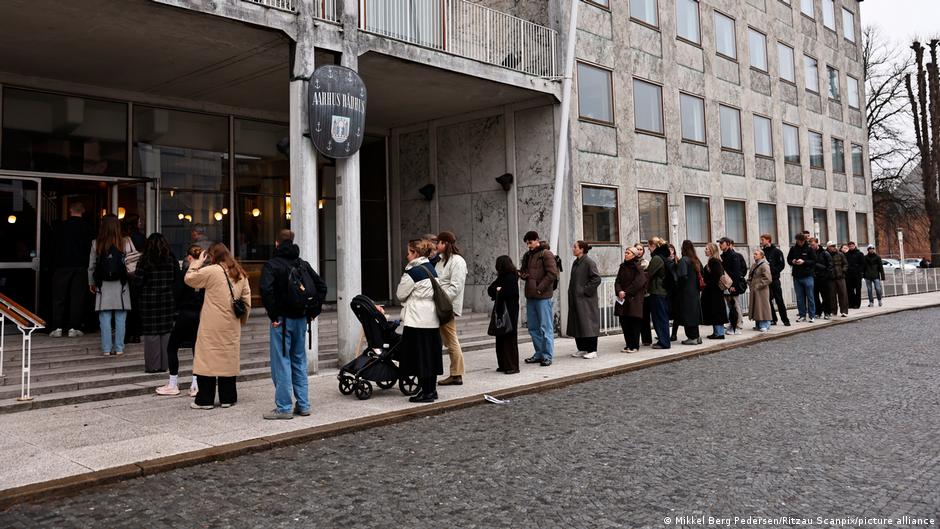
Danes took to the polls on Tuesday, delivering mixed results that could complicate Prime Minister Mette Frederiksen’s hopes for a third term.
Election exit polls conducted by the major television broadcasters DR and TV2 pointed to an unclear balance of power, with the three parties that have formed Frederiksen’s administration – the Social Democrats, the center-right Venstre and Foreign Minister Lars Lokke Rasmussen’s Moderates – all expected to fall well short of a majority.
Although her party is projected to come in first, is not entirely certain how, or if, Frederiksen will be able to secure a third term as prime minister.
This could put Rasmussen in the position of kingmaker, with his centrist party well placed to determine whether Fredriksen could secure her third term.
In the wake of having steered the country in the fight against President Donald Trump’s threat to seize Greenland, the 48-year-old Social Democrat called the vote months before an October deadline.
Her party had been bolstered with Frederiksen having rebuffed Trump’s threat to take control of Greenland, an island in the Arctic Ocean that is a semi-autonomous territory controlled by Denmark.
But if the results hold, the vote would actually represent the worst result for Frederiksen’s Social Democrats since the start of the last century, sinking to between 19.2% and 21%, a dramatic fall from the 27.5% they won in the last election in 2022.
Voting overtaken by domestic concerns
Tuesday’s exit polls indicate that the political landscape in Denmark is more complicated than it may seem.
Voting concerns appear to have moved to the domestic tack, with concerns like a proposal for a wealth tax and debates about immigration having climbed back up to the top.
Frederiksen had campaigned on a promise that her tough and tested leadership skills will help the nation of 6 million navigate a complex relationship with Washington and a European response to Russia’s war with Ukraine.
A fragmented political landscape
Frederiksen has led Denmark since 2019, when she became the country’s youngest-ever prime minister at 41 years old.
She was credited with having headed a coalition government that bridged the left-right divide for the first time in more than 40 years.
But the political landscape has since fragmented, with 12 parties contesting the ballot this time.
Projections show that the left-wing bloc that includes Frederiksen’s Social Democrats is narrowly ahead but still expected to fall short of the 90 seats needed for a majority in Denmark’s 179-seat parliament.
Additionally, four seats allocated to candidates from Greenland and the Faroe Islands may prove decisive.
“I think it’s the most important election for the Danish parliament in Greenland in history,” Greenlandic Prime Minister Jens-Frederik Nielsen told AFP in Nuuk. “We are in a time where we have a superpower trying to acquire us, take us, control us.”
Nielsen said regardless of whoever gets elected for parliament, “The most important thing that all the parties in Greenland have agreed on is that we need to work together.”
With the left-wing bloc expected to hold firm and the right-wing bloc expected to fragment, Frederiksen remains the favorite to pull together a parliamentary majority to govern a coalition.
Edited by: Wesley Dockery
